



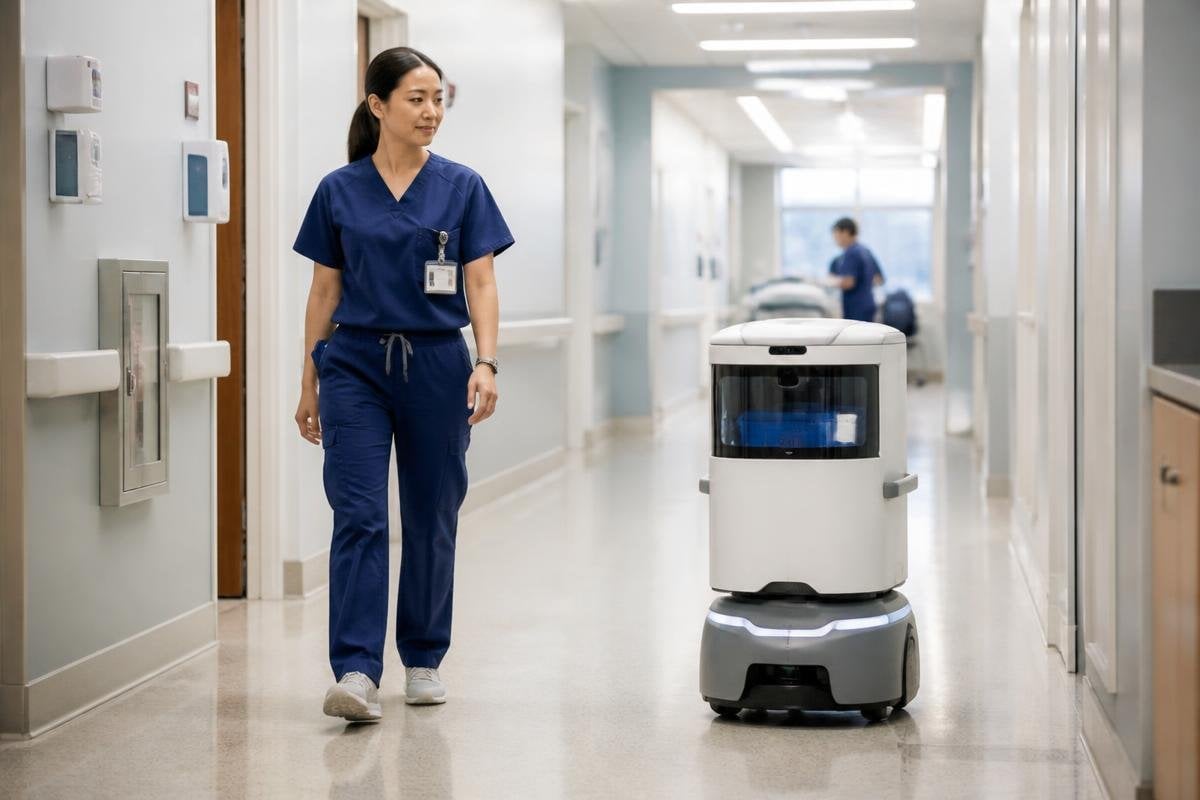
A nurse can lose time walking for supplies, moving samples, or finding a free bed. Robots could take on some of those trips, giving nurses more time for work that needs judgment and direct contact with patients.
- Mobile robots can move supplies, meals, linens, and lab samples inside a hospital.
- Software can send a task to the right robot and show where it is.
- The hard parts are crowded corridors, lifts, infection control, and safe handoffs.
Where robots can save time
The clearest use is transport. Inside a hospital, a mobile robot can carry a sealed container from a ward to a lab, or take clean supplies from storage to a nursing unit. That removes a walking task from a nurse’s shift without changing who makes care decisions.
The same idea applies to meals, linens, waste containers, and equipment. Each trip may be short, but repeated trips add up across a busy ward.
For these jobs, the robot needs a secure compartment, a way to stop for people, and clear signals when it reaches its destination.
Some hospitals may also use robots to bring items to a patient room. That still needs a nurse or another staff member when the item requires explanation, fitting, or a check. The robot carries the object. A person remains responsible for the care step.
How the system would work
A hospital robot needs more than wheels and a battery. It needs a map of approved routes, sensors that detect people and obstacles, and software that connects its tasks to hospital work systems.
A nurse might request a delivery from a workstation or a mobile device. The system would assign the job, send the robot to a storage point, and record the handoff. The container then needs a clear owner and destination so the task does not end with a robot waiting beside a lift.
Handoffs matter because hospitals have many access rules. A robot may need a badge reader for a locked room, a lift interface for different floors, or a staff member to confirm receipt. If those steps take too long, the walking task has only moved to another part of the process.
A nursing robot saves time when its route ends with a usable handoff, not another task for staff. Reports from Robot24 can tie that claim to a named machine, hospital, task, and date. The limits matter just as much, because a robot can move supplies but cannot decide what care a patient needs.
What robots cannot take over
Nursing includes observation, communication, and decisions made from changing patient conditions. A transport robot can move a tray. It cannot decide that a patient looks confused, needs help to sit up, or has changed since the last check.
That limit should shape the design. The machine should reduce errands around patient care, not add screens, alerts, and recovery work for staff. Nurses also need a fast way to stop a task, report a problem, and call a person when the robot reaches a blocked route.
Privacy brings another limit. A robot moving through a hospital may use cameras, depth sensors, or other systems to detect obstacles. The hospital must set clear rules for where that data goes, how long it stays, and who can view it.
The strongest opposing view is that robots could make care feel less personal. That risk is real when a machine replaces a conversation or leaves a patient unsure whom to ask for help. It is smaller when the robot handles transport and the nurse stays present for care.
A buying checklist for hospital teams
Before a hospital tests a robot, the team should check the work around it, not only the machine.
- Name the task: Count the walking trips, handoffs, and delays tied to one job.
- Map the route: Check doors, lifts, narrow halls, floor changes, and busy times.
- Set human control: Give staff a clear stop button and a quick way to report faults.
- Check the handoff: Decide who loads the container, who receives it, and how the record is kept.
- Review privacy: List the sensors in use and set rules for stored data.
- Measure the result: Compare staff time, missed tasks, robot stops, and repair calls before expanding use.
That last check decides whether the machine belongs in the ward. When deliveries create extra calls for nurses, the workload has shifted rather than fallen.
I’d back nursing robots for transport first, with a small ward trial and a clear measure of staff time. The next useful proof is not a polished video. It is a full shift showing how many trips the robot completes, how often people must intervene, and what nurses do with the time it gives back.